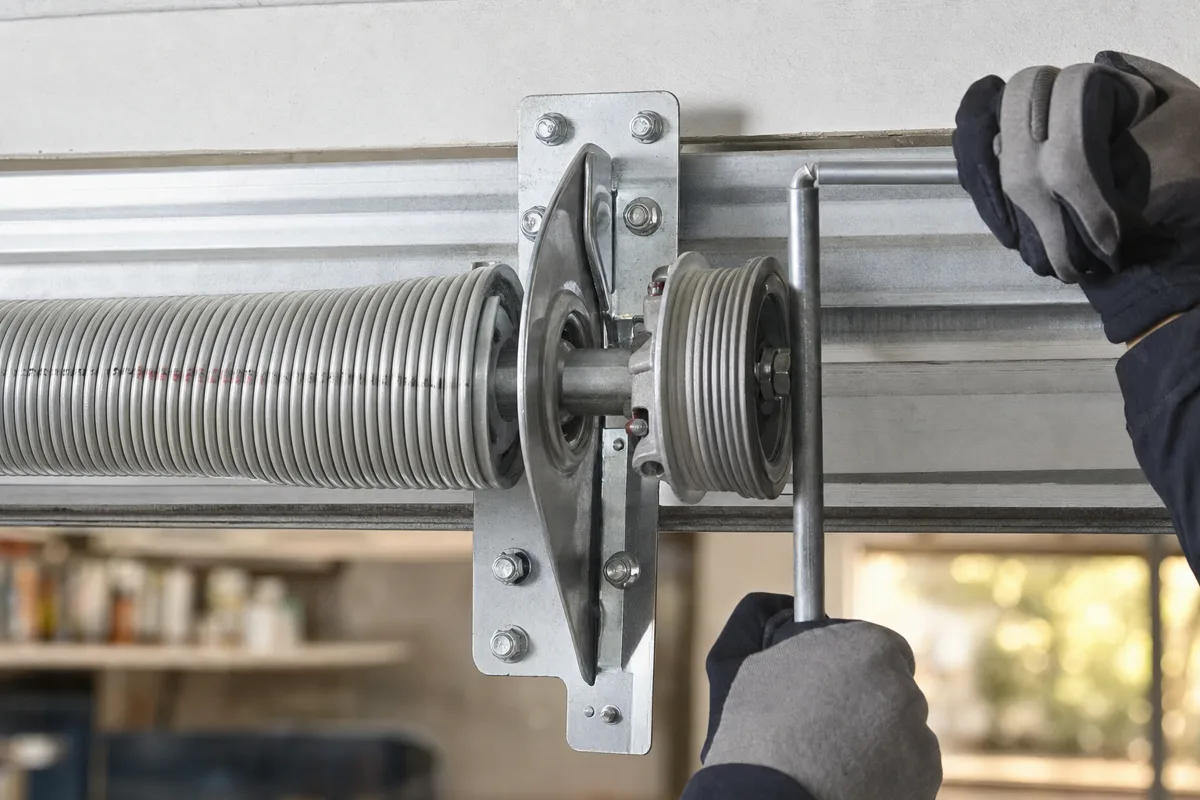

Garage Door Spring Replacement
Broken torsion and extension springs swapped out using proper winding bars.
View serviceSprings counterbalance the door for controlled movement. If one fails, the door may become unexpectedly heavy or stop partway. Observe from a distance, avoid repeat tests, and never handle spring or cable hardware.
A failed garage-door spring often leaves the door unusually heavy, unable to rise properly, or stopped while the opener strains. A torsion coil may show a visible break, or you may recall a sudden loud crack. Do not operate the opener again or touch springs, cables, drums, or lower brackets. The system can still hold dangerous stored force.
A garage door spring supplies much of the lifting assistance needed to move a heavy door. If that counterbalance disappears, an opener may hum, lift only a short distance, or reverse because it cannot manage the load. A sharp crack from the garage can also mark the moment of failure. Some doors use a torsion spring above the opening, while others have extension springs near the horizontal tracks. Either layout contains stored energy and is not suitable for homeowner adjustment. The safest approach is to identify the visible clues with the door down, avoid forcing it manually, and arrange professional service before the opener or another part of the system is damaged.
Start at the top. The early checks are the most common causes and need no tools.
With the door fully closed, stand several steps back and examine the spring assembly over the header for a clear separation in a coil. Other doors use springs beside the upper tracks. Compare what you can see without touching, pulling, or placing any object near the springs or their end fittings.
What it means: A visible gap through a torsion coil is clear evidence of a failed spring.
Consider whether the issue began with a loud report from the garage. A spring can break with a sharp sound even when the door is shut and looks unchanged afterward. If the opener then began struggling, do not dismiss that sound as an ordinary impact or continue trying to raise the door.
What it means: A loud bang followed by a heavy door strongly suggests lost spring support.
If you have not already tested it, use one brief command while observing the door from clear of the opening. Stop immediately if it lifts only a few centimetres, reverses, or the motor hums. The opener is intended to move a balanced door, not to haul the full door weight.
What it means: An opener that cannot lift a formerly normal door may be compensating for a broken spring.
During that single attempt, watch from a safe position for one bottom corner rising ahead of the other or for a cable that appears loose. Do not pull an emergency release, particularly when the door is not fully down. Uneven motion indicates the lifting system is no longer controlled.
What it means: A slack cable or one-sided lift means the door must remain out of service.
There is no need to prove a suspected spring break by lifting the door yourself. If the visible spring, sound, or opener behaviour points to missing counterbalance, stop there. Keeping a heavy door down and arranging service is safer than attempting to judge its weight or balance by hand.
What it means: Choosing not to force-test a heavy door is the safe conclusion when spring failure is likely.
Spring replacement is not a homeowner task. Torsion springs, winding fittings, lift cables, drums, and lower brackets can release energy with enough force to cause serious injury. Do not loosen a set screw, insert a tool into winding hardware, cut a spring, or attempt to re-seat a cable. Do not use the opener as a substitute for spring support. Keep the door closed if possible and request service through the online booking form.
At the Buttonville climate station in Markham, January's mean daily minimum is −10.1 °C, and the recorded low is −35.2 °C. Cold does not by itself prove why a spring failed, but it can reveal an already fatigued spring when the door is used on a severe morning. Watch for earlier changes such as a door that sounds rougher, rises less evenly, or makes the opener work harder. A cold-weather failure still needs the same response: stop operating the door and have the counterbalance system assessed professionally.
Fill out the form and we'll confirm your appointment by email.
These guides are written for Markham homes. If the fix is beyond a homeowner check, we work everywhere inside this area.
Map data © Google. Pin shows the service area, not a walk-in location — all work is done at your home.

A real callout, not stock imagery.
A sectional door pulled off its tracks, taken down and supported on site so it could be checked and re-hung safely — photographed on the job.