
Garage Door Spring Repair
Balance and tension corrected on springs that are still sound but out of adjustment.
View detailsBroken torsion and extension springs swapped out using proper winding bars.

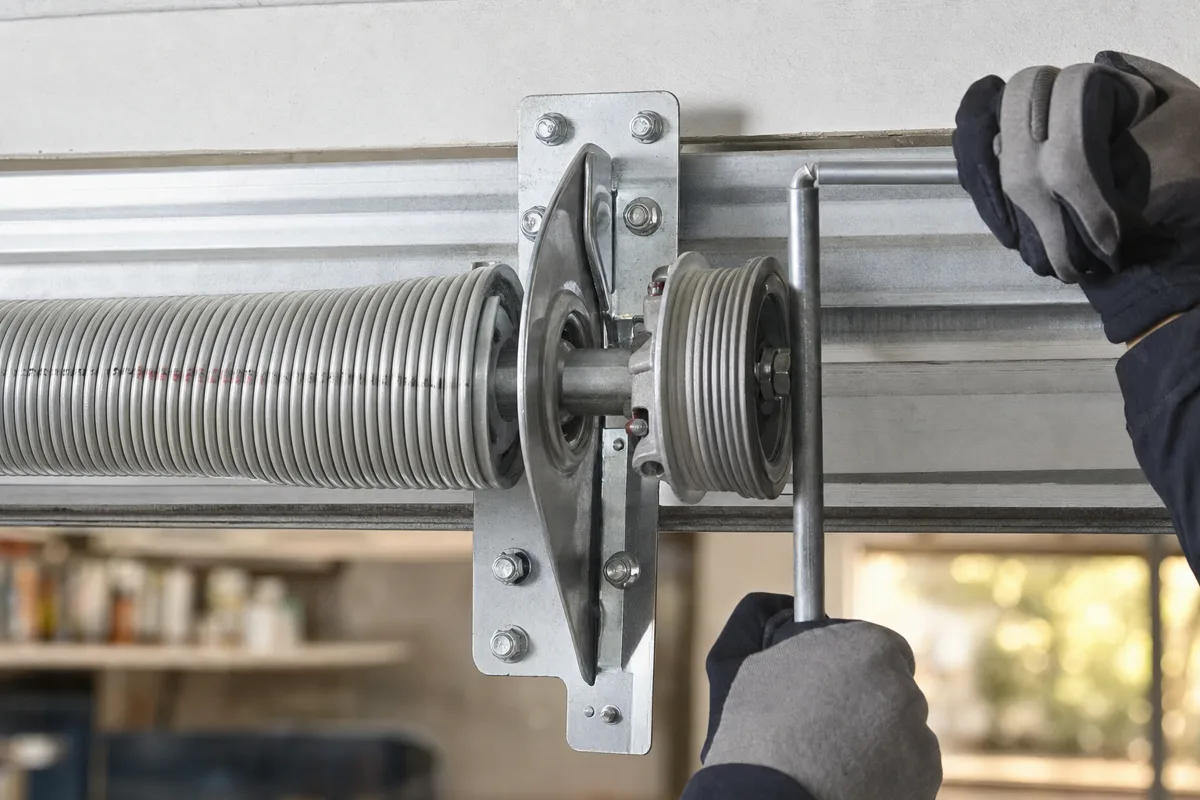
Replacing a garage door spring restores the counterbalance that allows a sectional door to travel without excessive force. The replacement is selected from the door now in place, not from a visual match to the old coil. Door weight, height, shaft arrangement, drums, track layout, and cable configuration determine the required torque. The existing spring is removed under control, the matched spring is installed and tensioned, and door balance is verified before the opener returns to service. A proper replacement also checks the hardware that may have contributed to the original failure.
A standard torsion spring is often specified for about 10,000 operating cycles, which can equal roughly 7 to 12 years in a regularly used home. Frequent operation, corrosion, or a door that drags can shorten that span. Once a spring breaks, replacement is required. If the current door has gained weight or its paired coil is unlike the other, the new selection must be calculated from the system now installed.
Work through the symptom first — some of these turn out to need no technician at all.
Spring wire repeatedly twists as the door moves, eventually reaching its usable cycle limit. A break often leaves a distinct gap in the coil. This is expected wear for a working component, although heavy use, corrosion, and poor door movement can bring it forward.
A door can weigh differently after insulation, decorative hardware, replacement sections, or water-damaged materials are added. Springs chosen for the original configuration may then provide too little or too much force. Measuring the current door prevents copying a specification that no longer matches.
Rust and surface pitting create stress points in spring wire. Damp conditions do not guarantee early failure, but they can shorten the useful life of a coil that is flexed thousands of times. Corrosion also warrants examination of nearby cables, bearings, and lower hardware.
Two-spring systems need compatible force on both sides of the shaft. One earlier replacement may differ from the remaining spring, or one coil may have weakened faster. Uneven assistance affects balance and can place added force on cables, drums, rollers, and the opener.
Markham's newer subdivisions are now old enough for original lift hardware to deserve closer attention. Greensborough development began in 2005, while Cathedraltown was established in 2006. If a door in either area is original to the build, its springs may have accumulated many years of daily cycles even when the panels still look sound. That is a reason to measure the current door and inspect the full lift system, not a reason to assume every property uses the same spring. Household use, later alterations, and the actual door weight still determine the right replacement.
Spring replacement involves high stored energy. The shaft, cables, drums, and winding cones can move abruptly if tension is released in the wrong sequence. Do not use household screwdrivers in place of proper winding tools, loosen a cone, or remove a cable from a loaded system. A door with a broken spring may be much heavier than expected, even when it looks intact. Keep it closed where possible and submit the online form for a confirmed booking.
The door's weight and lift arrangement are assessed so wire size, inside diameter, length, winding direction, and cycle rating can be selected for the system. This avoids assuming that an old or visibly similar spring provides the right torque for the door.
The door is stabilized before existing spring tension is removed with appropriate equipment. Shaft, drums, and cables are kept under control during disassembly, because their alignment affects whether the replacement can provide equal lift at both sides of the door.
The replacement spring is positioned on the shaft with its proper cones, drums, and bearing components. Supporting hardware is checked and secured before working tension is applied. A component that is visibly damaged or incompatible is not left to undermine the completed installation.
After tension is set, the door is levelled and operated manually to confirm balanced movement through its range. The opener is connected only after this check. Its limits and safety operation are then assessed with a door that the motor is not being asked to lift.
Balance and tension corrected on springs that are still sound but out of adjustment.
View details
Slack, frayed, or snapped lift cables replaced and rewound onto the drums.
View details
Fault-finding on openers that hum, stall, reverse, or ignore the remote.
View detailsFill out the form and we'll confirm your appointment by email.
Garage Door Spring Replacement is available across every Markham neighbourhood inside the area below.
Map data © Google. Pin shows the service area, not a walk-in location — all work is done at your home.

A real callout, not stock imagery.
A sectional door pulled off its tracks, taken down and supported on site so it could be checked and re-hung safely — photographed on the job.