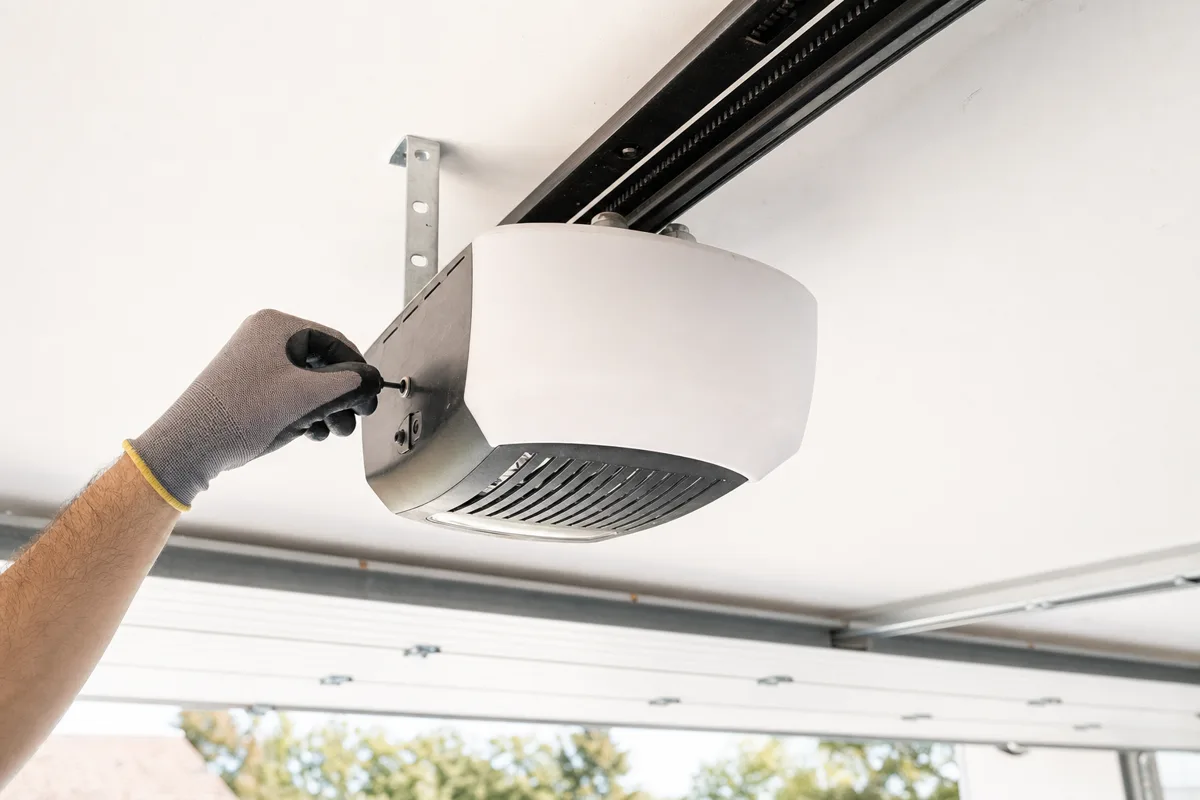

Garage Door Opener Installation
Quiet belt-drive and smart openers fitted with rolling-code security.
View detailsFault-finding on openers that hum, stall, reverse, or ignore the remote.

A garage door operator is the powered device that moves an already balanced overhead door. The problem can be in the power supply, controls, remote signal, photo-eyes, travel settings, trolley, rail, drive gear, chain, belt, or motor circuit. It is important not to blame the opener without checking the door first. Resistance caused by a failed spring, restricted roller, or cable fault can make an otherwise working unit strain or reverse because the door is no longer properly balanced. The manual door is assessed first, followed by the opener's electrical and drive components.
An opener's service life depends on use, drive type, maintenance, and especially door balance. A well-balanced door places much less demand on the motor, gear, rail, and arm than a door with a failing spring or tight track. Sensors, remotes, and a trolley can often be dealt with separately. Replacement becomes the practical option when core components are unavailable, major drive faults recur, or the unit no longer fits the door or household needs.
Work through the symptom first — some of these turn out to need no technician at all.
Photo-eyes mounted near the floor need an uninterrupted view of each other during closing. Dirt, snow residue, a moved bracket, damaged wiring, or light interference can interrupt the signal. The opener may reverse or refuse to close even though the motor and rail are functioning.
A motor can run while an internal gear, sprocket, trolley, belt, chain, or rail component slips. This can produce a humming or moving opener with little door movement. Diagnosis needs to identify the failed link rather than treating a running motor as proof that the drive is intact.
Travel settings tell the opener where to stop, while force sensing responds to resistance. Drifted settings or extra door friction can cause early reversal, incomplete opening, or hard floor contact. A setting should not be increased to conceal a door that binds or has lost balance.
A spring, cable, track, or roller fault increases the load seen by the opener. Its safety response can interpret that resistance as an obstruction and reverse. In this situation, the powered unit may be responding correctly to a door problem rather than being the original failure.
Cedarwood's housing stock is largely from 1991 to 2010, with 45 percent reported as built between 2001 and 2005. If an opener is original to one of those builds, its drive gear, rail connection, sensors, and controls may now be approaching an age where condition matters more than appearance. That does not mean every Cedarwood opener needs replacement: a failed remote, misaligned photo-eye, or worn trolley may be a separate repair. Start with the door's balance and a component-level diagnosis, rather than assuming a motor problem from the age of the property alone.
Basic checks such as cleaning sensor lenses, replacing remote batteries, and confirming the unit has power are lower risk than spring work. The door itself still requires caution. Do not bypass photo-eyes, increase the force setting to move a heavy door, or work inside an energized motor housing. If the door is heavy by hand, crooked, or scraping, stop troubleshooting the opener. The mechanical cause must be assessed before the powered system is returned to regular use.
Where conditions permit, the opener is disengaged and the door's manual movement is evaluated. This shows whether the unit is dealing with a balanced, freely moving door or being asked to overcome a mechanical load that should be corrected before any electrical adjustment.
Power, wall controls, remotes, receiver response, photo-eye alignment, wiring, and indicator lights are tested. These checks narrow the fault to a safety circuit, signal issue, power concern, or drive-related condition without replacing parts based on a single symptom.
The rail, trolley, door arm, belt or chain, sprocket, and accessible internal drive parts are examined for wear, disengagement, or damage. The fact that a motor turns does not mean that every part between the motor and the door is still engaged.
After repair, travel limits and force behaviour are set for the corrected door condition. Photo-eye reversal and normal opening and closing are tested. The opener should reach both limits without excessive strain, unnecessary repeat cycles, or bypassing the safety features that protect the opening.
Quiet belt-drive and smart openers fitted with rolling-code security.
View details
Balance and tension corrected on springs that are still sound but out of adjustment.
View details
Annual service: lubrication, hardware torque, balance test, and safety checks.
View detailsFill out the form and we'll confirm your appointment by email.
Garage Door Opener Repair is available across every Markham neighbourhood inside the area below.
Map data © Google. Pin shows the service area, not a walk-in location — all work is done at your home.

A real callout, not stock imagery.
A sectional door pulled off its tracks, taken down and supported on site so it could be checked and re-hung safely — photographed on the job.