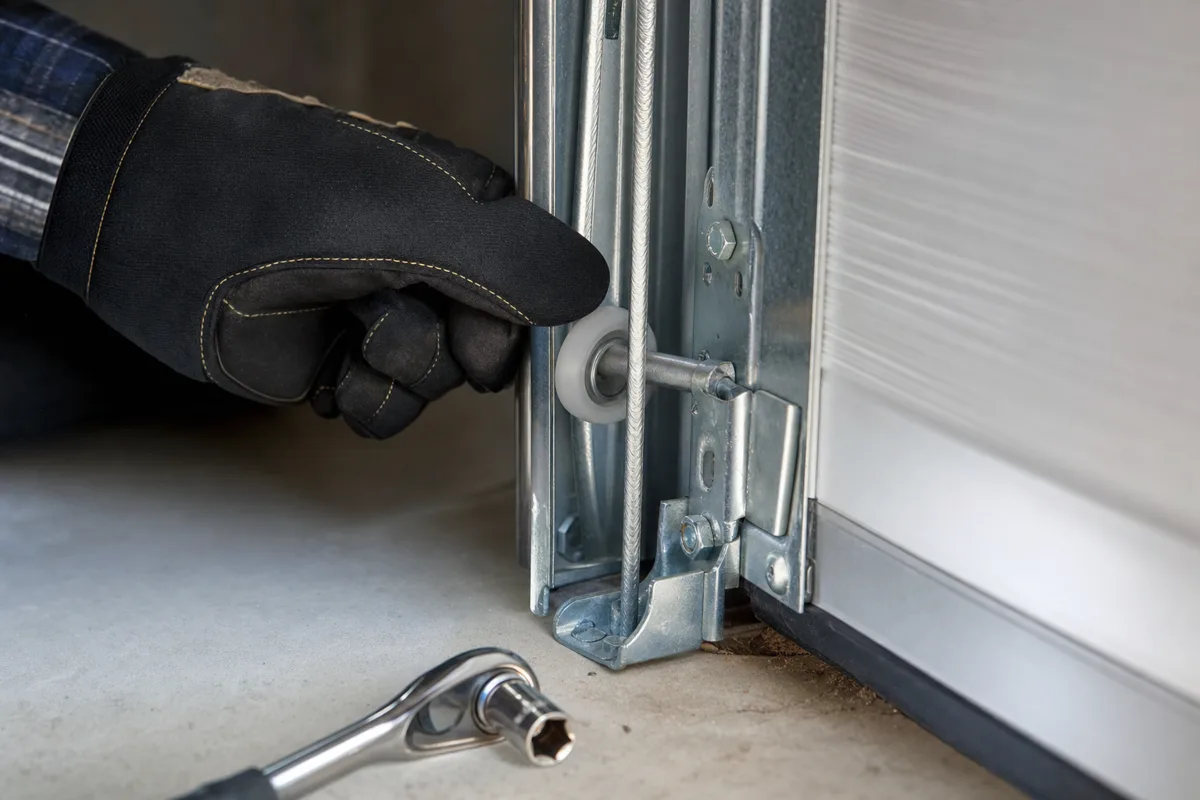

Garage Door Cable Repair
Slack, frayed, or snapped lift cables replaced and rewound onto the drums.
View detailsDoors put back on track, seized rollers renewed, and bent rails straightened.

Tracks and rollers guide every section of the garage door from the opening to the overhead position. If that path is bent, loose, dirty, or worn, the door can shake, scrape, hesitate, or pull sideways even though the opener still has power. Roller and track repair covers cracked wheels, worn stems, loose hinges, damaged track sections, incorrect spacing, and brackets that have shifted. A sound at one corner can come from a misaligned bracket or worn component elsewhere. The goal is quiet, even movement without forcing the opener to overcome mechanical resistance.
Roller life varies by material, bearing design, alignment, and daily use. Basic rollers can become noisy or loose sooner than sealed-bearing versions, while a straight supported track can remain serviceable unless it is struck, corroded, or moved from its mount. Replace a roller when its wheel cracks, its stem has excess play, or it no longer turns freely. A small local track distortion may be repairable; severe deformation may need a replacement section.
Work through the symptom first — some of these turn out to need no technician at all.
Roller wheels and stems wear with repeated use and side pressure. A loose bearing or damaged nylon wheel can drag instead of roll, creating vibration and increasing the force needed to guide the door. The noise may be most obvious at one point in the travel path.
Contact from a vehicle, tool, or stored object can bend a vertical track inward or outward. Even a small change narrows or distorts the roller path. The door may scrape, hesitate, or climb at the same location each time it reaches the damaged area.
Track brackets hold the guide path at a precise distance from the frame. Loose fasteners or shifted mounting can spread, pinch, or twist the track. Rollers then receive side loading that they were not designed to carry, leading to noise and accelerated wear.
Suitable garage-door lubricant reduces normal friction at rollers, hinges, and bearings. When it dries out or collects dirt, movement becomes louder and heavier. Lubrication cannot correct a cracked wheel, a bent rail, or bracket alignment that has moved from its required position.
Cornell is known for extensive rear-lane access and detached garages, including rear-lane double-car garage townhomes. These structures can be unheated and are often reached from a laneway instead of the street. Winter cold can stiffen old lubricant, while snow and grit brought in from the lane can show up first at rollers and lower tracks. When booking track or roller work for a Cornell property, note that the garage is at the rear and keep the laneway access clear. A slow or noisy door in cold weather still needs a mechanical check rather than repeated opener force.
Roller or track damage can become hazardous when a heavy door is driven out of its guide path. Do not attempt to force an escaped roller back into the rail while the door is raised, adjust every track mount at the same time, or repeatedly operate through a scraping point. With the door down, you can remove loose debris from reachable areas. Bent rails, loose hardware, and displaced rollers should be corrected before ordinary use continues.
The door is watched through opening and closing to locate rubbing, shake, or hesitation. Where safe, manual movement helps determine whether the resistance is in the guide system itself rather than a control or motor issue that happens to appear at the same point.
Rollers, stems, hinges, track joints, brackets, and fasteners are inspected for cracks, looseness, side loading, and wear. Damaged rollers are identified before alignment is changed, because a worn wheel can make an otherwise correct track appear to be the issue.
Repairable track damage, bracket placement, spacing, and fastener security are addressed as needed. The objective is a continuous guide path that lets the rollers rotate freely while holding the door at the correct distance from the opening and framing. Mounting points are also checked for movement in the supporting framing.
Appropriate moving points are lubricated after mechanical concerns are addressed. The door is then cycled again to confirm that it moves evenly, seats at the floor, and has no remaining repeated scrape or vibration that would point to another worn component.
Slack, frayed, or snapped lift cables replaced and rewound onto the drums.
View details
Annual service: lubrication, hardware torque, balance test, and safety checks.
View details
Dented, rusted, or impact-damaged sections matched to the door you already have.
View detailsFill out the form and we'll confirm your appointment by email.
Garage Door Roller & Track Repair is available across every Markham neighbourhood inside the area below.
Map data © Google. Pin shows the service area, not a walk-in location — all work is done at your home.

A real callout, not stock imagery.
A sectional door pulled off its tracks, taken down and supported on site so it could be checked and re-hung safely — photographed on the job.