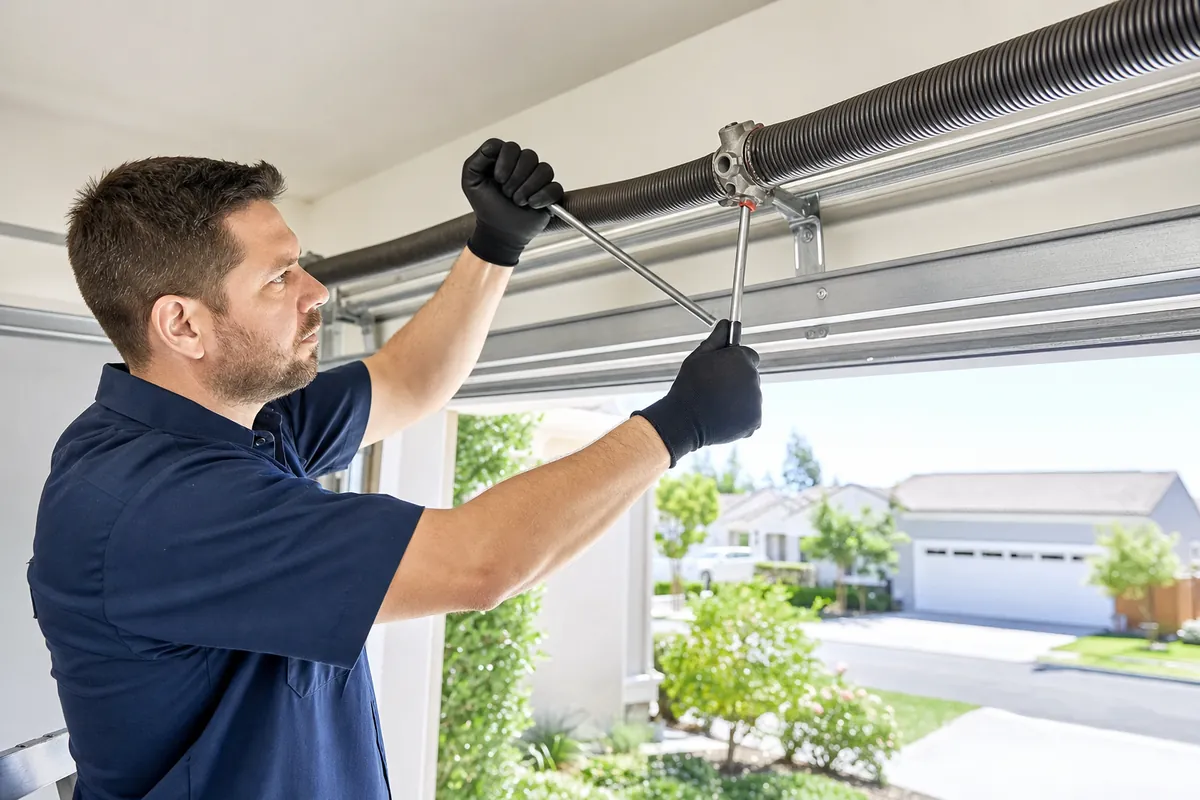

Garage Door Spring Replacement
Broken torsion and extension springs swapped out using proper winding bars.
View detailsBalance and tension corrected on springs that are still sound but out of adjustment.

The spring system should offset the door's weight so it can be moved smoothly without asking the opener to do the lifting. Spring repair examines problems within that counterbalance system, including incorrect tension, binding bearings, loose shaft hardware, or a spring that no longer suits the door. A snapped torsion spring is normally replaced, not patched; however, related components may be repairable when they are preventing a sound spring from working properly. The door's balance, lift hardware, and travel are checked before deciding on the correct work. Book the assessment with the online form.
Springs are rated in cycles rather than by a guaranteed calendar date. A common residential rating is approximately 10,000 open-and-close cycles, often around 7 to 12 years where the door is used normally. Usage, corrosion, door weight, and roller condition change that outcome. Correct sizing and freely turning bearings help a spring wear evenly; a broken coil normally calls for replacement rather than repair.
Our troubleshooting guides walk the diagnostic checks in order so you can confirm the fault before booking.
Spring steel bends and relaxes every time the door opens or closes. After enough cycles, fatigue can create a fracture or leave the system short of lifting force. The loss is often sudden to the homeowner, although the spring has been accumulating wear over time.
Spring dimensions and winding direction must suit the door's actual weight, height, drums, and lift arrangement. A weak spring leaves too much work for the opener, while an overly strong spring can make closing unpredictable and prevent the door from staying where it is placed.
The torsion shaft turns through centre and end bearings as the door moves. A bearing that is dry, worn, or seized interferes with that rotation. Instead of delivering spring force evenly, the system becomes noisy, uneven, and harder on the spring coils and cables.
Drums, winding cones, and set screws must remain fixed in their intended positions. When hardware moves, cable travel and stored spring force can change at the same time. The result may resemble an opener problem, but the underlying issue is often incorrect counterbalance behaviour.
At Buttonville Airport in Markham, January's mean daily minimum is −10.1 °C, and the station has recorded a low of −35.2 °C. In that cold, lubricant thickens and rollers or seals can add resistance to an already tired lift system. Cold weather does not usually break a healthy spring on its own, but it can reveal a spring that is near the end of its cycle life or hardware that is no longer moving freely. A door that suddenly feels heavy during a cold spell deserves a balance check instead of a higher opener-force setting.
Spring work is not a do-it-yourself adjustment. Torsion springs, winding cones, cables, and drums operate under stored force, and a slipped tool or released set screw can cause serious injury. Do not touch a spring with a visible gap, loosen fittings on the shaft, or make the opener haul a door that feels heavy. Leave the door closed if possible, avoid the hardware, and use the online form to arrange an assessment confirmed by email.
With the opener disengaged when conditions allow, the door is assessed by hand at several positions. Its weight and tendency to drift reveal whether spring assistance is low, excessive, uneven, or being masked by friction somewhere else in the operating system.
The springs, shaft, drums, cones, bearing plates, and brackets are examined as one assembly. This makes it possible to distinguish a fatigued spring from a binding bearing, loose fastener, or earlier installation mismatch that altered normal balance. This also checks whether the existing parts have been installed in a way that preserves proper cable alignment.
Repairable bearing, hardware, or adjustment issues are corrected where appropriate. A fractured or substantially fatigued spring is identified for replacement instead of being treated as a candidate for a short-lived repair. The door's actual load guides the work rather than appearance alone.
The door is moved through several manual positions to verify that it stays reasonably balanced and does not bind. Only then is the opener returned to use and checked, so its travel settings are not compensating for a problem in the lift system.
Broken torsion and extension springs swapped out using proper winding bars.
View details
Slack, frayed, or snapped lift cables replaced and rewound onto the drums.
View details
Annual service: lubrication, hardware torque, balance test, and safety checks.
View detailsFill out the form and we'll confirm your appointment by email.
Garage Door Spring Repair is available across every Markham neighbourhood inside the area below.
Map data © Google. Pin shows the service area, not a walk-in location — all work is done at your home.

A real callout, not stock imagery.
A sectional door pulled off its tracks, taken down and supported on site so it could be checked and re-hung safely — photographed on the job.